Better Leadership, Better Windsor: How Xsander Moisenko Will Transform Our Waterfront
Updated: Sep 29
Take a walk along our riverfront this weekend and look down. You will see cracked concrete, patched asphalt, weeds pushing through expansion joints, and paint that faded years ago. Then look up. You will see one of the finest river views in Ontario, a skyline across the water, and a city that deserves far better than what we have settled for.
Now compare that scene with the debate at City Hall. Windsor is moving forward on a plan to convert a shuttered hockey arena into 102 housing units, at a preliminary staff estimate of $55 million to $60 million. Meanwhile, the riverfront plaza that should be the crown jewel of our city still looks the way it did a decade ago.
That is the choice in front of us. It is not a choice between compassion and beauty. It is a choice between smart spending and expensive sentiment. Xsander Moisenko, candidate for Ward 4, has a plan that delivers both: a Community Recovery Village that costs a fraction of the arena conversion, with the savings directed to the waterfront we all love.

The Waterfront Opportunity
Windsor's waterfront is our front porch. It is where families walk on summer evenings, where couples take wedding photos, where visitors decide whether they like us. It is the single greatest asset this city owns, and we have treated it like a spare parking lot.
For years, we have known the Festival Plaza is not living up to its role. The city's own staff said as much. In December 2024, a city report recommended a $20 million redesign known as the Dynamic Destination Design. The plan called for a secondary stage, shade structures, water features, a centerpiece tree, green space, and walking paths. Alternatives came in at $17 million and $13 million.

In January 2025, council approved the master plan by an 8 to 3 vote. Ward 1 Councillor Fred Francis, Ward 2 Councillor Fabio Costante, and Ward 7 Councillor Angelo Marignani voted against it.
Here is the part every taxpayer should remember. The plan was approved. The full funding was not. Ward 3 Councillor Renaldo Agostino, who championed the plan, told council there was "no financial commitment today" and described the decision as one based on a vision. The city has about $12 million set aside for riverfront work over 10 years, but most of it is tied to 2029, and drawing on it sooner could mean interest charges. Construction still requires council direction, and the recommended $20 million design would need funding beyond what has been set aside.
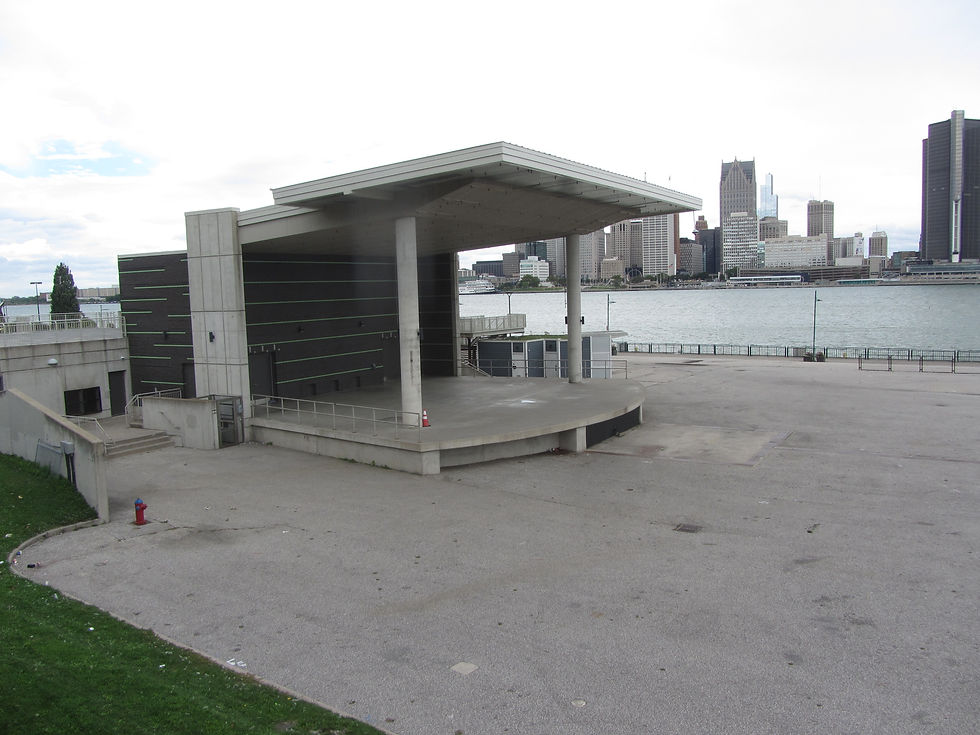
This is not a new story. In 2021, the city unveiled a dramatic $32.5 million canopy concept for the same plaza. Mayor Drew Dilkens himself described the site as "a stage in a parking lot." The canopy faded away. The asphalt stayed.

The campaign's own photographs tell the same story. Concrete slabs cracked and stained. Expansion joints filled with weeds. Faded parking lines on a surface that bakes in the summer sun. Standing water after a rain. Railings that have watched better days. This is not neglect that happened overnight. It is the slow cost of treating the riverfront as an afterthought.
Moisenko's approach starts with honesty about what we have. "We need real beautification of the main corridors, waterfront, and our green spaces," he has written. He adds that "parks and pathways should be clean, well-maintained, and inviting for families and visitors."

That is not a slogan. It is a standard. A waterfront with shade, seating, lighting, and green space is not a frill. It is how a city shows respect for the people who live here and attracts the visitors who spend money here.

And make no mistake about what is at stake. A vibrant waterfront is an economic engine. It is where festivals happen, where restaurants and shops want to be, where out-of-town guests spend money. Every year we leave the plaza in its current state, we leave value on the table.
This is not about grand monuments or vanity projects. It is about the basics done well and paid for honestly. Fix the surface. Add the shade. Repair the railings. Give people a reason to stay an hour longer, then another. Small, sensible investments repeated over time are how a waterfront becomes a destination, and destinations are built by cities that keep their promises.
Moisenko's waterfront vision is not a single expensive monument. It is a series of practical improvements that make the riverfront usable again: shade trees and gardens where cracked slabs sit today, places to sit and gather, a real performance space, accessible paths for strollers and wheelchairs alike, lighting that makes evening walks safe, public art that gives the space a soul, and a pavilion that welcomes people in every season.
The Arena Boondoggle
Now consider the other side of the ledger. The former Windsor Arena opened in 1927 and closed in 2012. It has sat largely empty ever since, a monument to decisions made and then forgotten.
In June 2026, council voted overwhelmingly to move forward with a plan to convert the building into supportive housing. The details matter. Council did not approve the full project cost. It authorized staff to investigate the building's condition, refine the numbers, and pursue funding from upper levels of government. Staff are expected to report back around next spring.

The preliminary staff estimate is $55 million to $60 million for 102 private, lockable dwellings, with health supports, laundry, and common areas. That estimate excludes annual operating costs, and it may change once the true condition of a building that opened in 1927 is fully understood.
Those unknowns are not a reason to abandon the goal of housing people. They are a reason to be honest with taxpayers about the price tag before the city commits to it. When a project's costs are still moving and its operating money has not been identified, responsible leadership asks harder questions instead of simply moving ahead.
Ward 1 Councillor Fred Francis was the lone vote against the motion, arguing the city should compare the conversion with demolition and new construction. He pointed to roughly $4.6 million in annual operating costs for the Minnesota model the plan is based on. Ward 3 Councillor Renaldo Agostino has said the project is not intended to be funded from the tax base and that the city would seek upper-government funding.

Read that again. A project with a $60 million price tag and no confirmed funding source is moving forward while the approved waterfront plan waits for the funding to build it. By the city's own estimate, the arena plan works out to roughly $540,000 to $590,000 for every single dwelling.

The Community Recovery Village Advantage
Moisenko's plan does not abandon people in need. It houses more of them for less money.
His Community Recovery Village is a 400-bed campus built from durable, repurposed shipping containers stacked two high. Each structure holds 16 residents in dual-occupancy units. The campus would be fully enclosed and secure, with medical and psychiatric triage, intensive addiction treatment and detox support, educational and vocational classrooms, and fitness and recreation space.
The campaign's projections are $45,000 per bed in capital costs and $12,500 per bed annually to operate. That works out to $18 million to build four times the capacity of the arena plan, and about $5 million a year to run it.
Why modular? Because it can be built faster, scaled in phases, and delivered at a cost that does not require mortgaging the city's future. The units are durable, repurposed shipping containers, the kind of practical, proven construction that other cities have used to move people off the streets quickly.
The village also keeps its focus where it belongs: recovery. A secure campus with medical and psychiatric triage, treatment, and accountability offers a real path forward, not a permanent warehouse for human suffering. That is the compassionate choice, and it happens to be the affordable one.
The approach fits the priorities Moisenko has campaigned on from the start: fiscal restraint, transparency, public safety, and a city that looks after its people and its places. It also respects a simple principle too often forgotten at City Hall. A dollar spent wisely on housing and recovery is a dollar that can still be spent on the parks, roads, and riverfront that every resident uses.
Compare that with $55 million to $60 million for 102 dwellings. The village houses roughly four times as many people for less than one third of the capital cost at the arena project's lowest estimate. It would be built on appropriately zoned industrial or commercial land, which minimizes disruption to residential neighborhoods.
Here is the connection that matters to every ratepayer. The savings from choosing the modular model do not disappear into a general revenue account. Moisenko's campaign commitment is to direct them to the waterfront rather than a larger general budget, without raising taxes. Better care for those who need it. Better use of tax dollars. A better waterfront. No tax increase required to get there.

Leadership That Pays for Progress
Critics will say this is too simple, that big problems need big buildings and bigger budgets. Moisenko answers with a philosophy.
"I oppose tax increases and unchecked growth in the municipal budget," he has written. His view of government is simple: less is more.
He also rejects the idea that a cared-for city is a luxury. "We can have good roads, safe bike infrastructure, beautiful public spaces, and a city that feels cared for if we budget carefully and prioritize properly," he writes.

And he warns that waiting solves nothing. "A revitalized city does not happen by accident." It takes leadership willing to make choices instead of deferring them.
Look closely at how decisions actually get made at City Hall. A plaza master plan approved by an 8 to 3 vote sits waiting for money. A $60 million arena conversion with no confirmed funding source moves forward. Priorities are revealed by what we fund, not by what we announce.
That is the real difference in this campaign. One approach spends the most money on the hardest problem and hopes the province and Ottawa pick up the tab, while the waterfront plan waits for the funding it still needs. The other approach builds more housing for less money, treats addiction and recovery as a serious public responsibility, and uses the savings to make our riverfront a place every resident can be proud of.
Living better does not require spending more. It requires better, more creative leadership.
If you believe our waterfront deserves more than cracked concrete and unfulfilled plans, if you believe tax dollars should be treated like they came out of your own pocket, and if you believe this city can care for its most vulnerable and still look after its greatest asset, then Ward 4 has a clear choice this fall.
Vote Xsander Moisenko. Better leadership. Better Windsor.


Comments